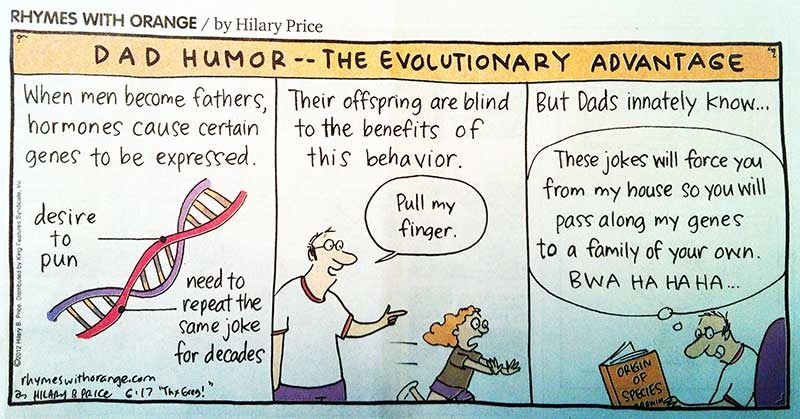
With thanks to cartoonist Hilary Price. Used without permission.
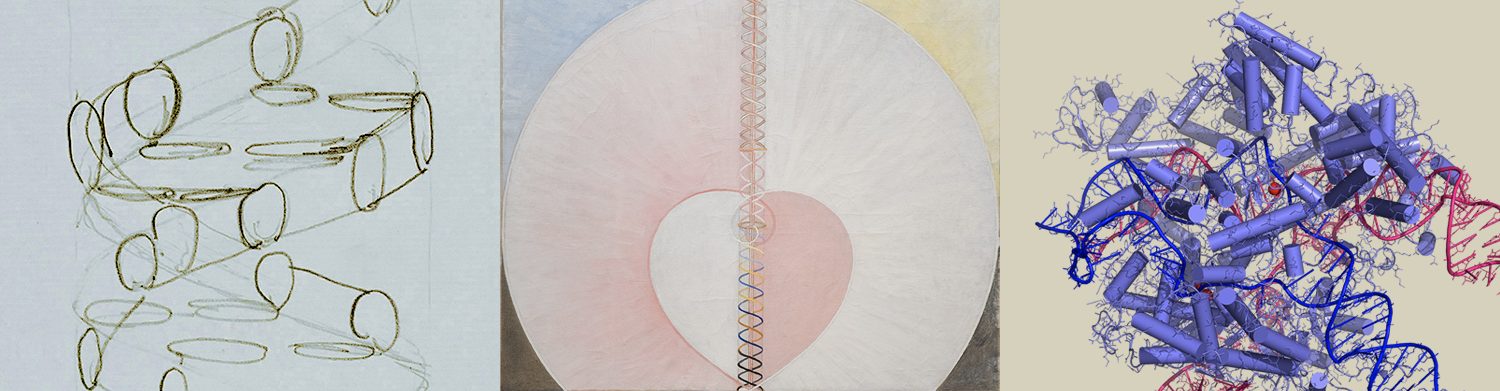
With thanks to cartoonist Hilary Price. Used without permission.
In an ongoing effort to unravel the mysteries of DNA, I recently completed a class at UC Berkeley, “Introduction to Genetic Analysis.” This essay, “What is a Gene?” was part of my final. Although the question could easily pass as a Zen koan, I gave it a shot.
What is a Gene?
To paraphrase Nature reporter Helen Pearson, ‘gene’ is not your typical four-letter word. Unlike most four-letter words whose definitions are well understood, the definition of a gene remains elusive. The more scientists learn about genes, the more the definition seems to fray around the edges. A question such as ‘How many genes are in this organism?’ is difficult to answer conclusively without a consistent description. In 2006, one research group examined the results of 77 experiments counting the number of genes in the human genome; none produced the same result (Liolios et al, 2006 doi:10.1093/nar/gkj145). From the smallest virus with three functional genes to humans with approximately 22,000, counting genes is challenging.
With roots in Mendel’s research on garden peas, the term “gene” has evolved from its original definition of a “unit of inheritance” to one that reflects advances in molecular biology. A commonly accepted definition is that a gene is a region of nucleic acid that specifies an RNA or protein. This definition encompasses both single- and double-stranded DNA and RNA. Exons, coding regions of DNA and RNA that are translated into protein sequences, are found in most, but not all genes. To incorporate a finding that proteins can be produced from non-coding exon regions, some geneticists have added “flanking regulatory elements” to this definition (Pesole, 2008 doi:10.1016/j.gene.2008.03.010). This addition incorporates genetic curiosities such as the lac operon, which allows bacteria to digest lactose. Newer definitions may emphasize functional products—counting proteins or RNA—rather than specific DNA loci. More precise definitions that apply to specific types of organisms, e.g., eukaryotes, seem inevitable.
After the discovery of the structure of DNA by Watson and Crick, mechanisms describing DNA replication, transcription and translation quickly followed. DNA, which functions as a “parts list” of molecular information, stores an organism’s functional repertoire. The addition of molecular information to biology provided a physical basis for understanding heredity, which in turn led to the surprising finding that organisms share many genes in common. This commonality has provided insight into the evolution of various species. Through the lens of evolution, genes exist to convert the molecular information stored in DNA into self-sustaining multicellular organisms. Organisms with adaptive genes transmit their genetic information to the next generation to ensure the successful propagation of the species.
In 1955, the year Watson and Crick’s paper appeared, Einstein was asked to define “light quanta,” or what are now commonly called photons. His response was:
All these fifty years of conscious brooding have brought me no nearer to the answer to the question, ‘What are light quanta?’ Nowadays, every Tom, Dick and Harry thinks he knows it, but he is mistaken. (Born, 1971 The Born-Einstein Letters)
In the ensuing fifty years, particle physicists arrived at a consensus describing photons (the so-called Standard Model). In genetics, the results from the Human Genome Project in 2000 provide a foundation on which to build future results. A clearer answer to the question ‘What is a gene?’ is emerging. The answer to this question will provide more accurate interpretations of the similarities and differences between individuals and species.

Along with Leila Jamal and Aaron Vollrath, I recently joined Genomera (now defunct) as a group guide in the genetics discussion group. Still in beta, Genomera enables personal health collaboration by providing a platform for crowdsourced health studies.
Genomera Interview
Thomas Pickard serves as an advisor to DIYgenomics, Althea Health, and the Coleman Research Group. He is Vice President of Marketing & Business Development at PACSGEAR, a company that integrates medical images with electronic health records. Previously, Thomas held roles at Emageon, eMed Technologies, and Thinking Machines.
In the early 90’s, I learned a little about bioinformatics at MasPar, a company that sold supercomputers for research. The ‘ah ha’ moment came from reading George Church’s article about the Personal Genome Project in Scientific American, which advocated getting your genome sequenced as a “lifestyle choice” (!) Shortly afterwards, I began work on an MBA and finished research on the $1000 genome in 2009. Since then, I’ve been immersed in genomics and its implications for personalized medicine.
On Genomera, a useful side-effect from the Restless Legs Syndrome and Niacin study was learning that my ferritin level was extremely low, which appears to have a genetic basis. Iron supplementation has made a difference, but more importantly, Genomera has allowed me to ask better questions. I have learned more about RLS in the past few months than I have in the past 20 years living with the disease. Over the next five years, we’ll all be able to ask better questions through the mining of genomic information.
Genomera is unique because participants can elect to share genomic information as part of a study. As Genomera expands, I would like to see studies that analyze results and genetic variants across studies—a true game changer for personal health and wellness.
I presented results from my self-tracking study at the Quantified Self San Francisco meetup at WellnessFX in San Francisco.
Experiment
By participating in this a crowd-sourced study on Genomera (now defunct), I tested niacin supplementation as a potential treatment for Restless Legs Syndrome (RLS).
Methods
The protocol is based on ramping up from 0 mg to 1000 mg of niacin over one month. I had to taper off my current medication that I have taken for 10 years, clonazepam, for a week and then take nothing for a control week.
I recorded some sliding scale measurements of RLS sensation, leg jerks, sleep, etc. in a spreadsheet (above), and worked with Genomera to create an “instrument,” a web page for data entry. I used Tonic to remind me to take niacin with meals, and Fitbit to record my sleep.
Results
Two weeks after taking niacin (500 mg/day), I did not see any improvement so I stopped taking niacin. Afterwards, I saw my doctor and we had a great discussion about the genetic factors that contribute to the disease. He also suggested that I check my ferritin level, since some people with RLS have this hidden iron deficiency. I learned that my ferritin level is very low, so I am starting an iron supplement. With luck, I will be able to report some improvement in my RLS in a future post.

I posted my 23andMe results to Genomera (now defunct), a new site designed to crowd-source health discovery. It’s something like “Facebook meets genomics.” My Genomera profile contained a link to my genome– eventually, I will also post trait information that I am gathering with Traitwise.

Yesterday, I received my results from 23andMe (just 25 days after mailing them). I will review and post them soon.
 I sent my saliva sample to 23andMe today.
Submitted to FDA’s Molecular and Clinical Genetics Panel of Medical Devices Advisory Committee on May 2, 2011:
In the US, we have a recognized lack of trained genetic counselors and physicians to support the interpretation of genomic information. FDA must address how we will educate healthcare professionals in sufficient numbers to assist with interpretation. Until then, US-based DTC genomics companies such as 23andme, Navigenics, Counsyl and others provide valuable education services to consumers about certain genetic conditions. By requiring informed consent, providing responsible information, and making no claims, these companies must continue their innovative work with a minimum of regulatory oversight because they fulfill an unmet need in our healthcare system. Also, since genomic testing is easily offshored, requiring a medical professional’s signature will not deter consumers from obtaining this information. Consumers want transparency from DTC genomics companies and generally want choice when deciding how their genomic information will be shared with others. Government plays two critical roles in this process: 1) ensure trust in DTC genomic results through regulatory standards such as CLIA, and 2) enforce the privacy of genomic information through regulatory acts such as HIPAA and GINA.
Update (July 2014): I began an executive MBA program at St. Mary’s College in 2007 and finished in early 2009. Several personal genomics companies (deCode Genomics, 23andMe, Navigenics) came of age during this period, and I was fascinated by the idea of the $1000 genome. I completed this research just before the publication of Kevin Davies’ book, which covers the early development of these companies in much greater detail.
 GenomeDad Blog